

 INFN-LNF Laboratori Nazionali di Frascati
The experimental activity on ADONE with colliding beams began in 1969 with four experiments, run by groups from several italian institutions, with the aim of studying many aspects of the electron-positron interactions, such as the test of quantum electrodynamics predictions, the search for new vector mesons and leptons heavier than the electron and the muon, the measurement of the production rates of muon pairs and hadrons.

The “Gamma-Gamma” Experiment (with researchers from Frascati and Rome) had, as a principal goal, the detailed study of reactions with neutral particles in the final state. Its experimental setup included scintillator counters following lead plates for the conversion of the photons and spark chambers to show the produced showers.
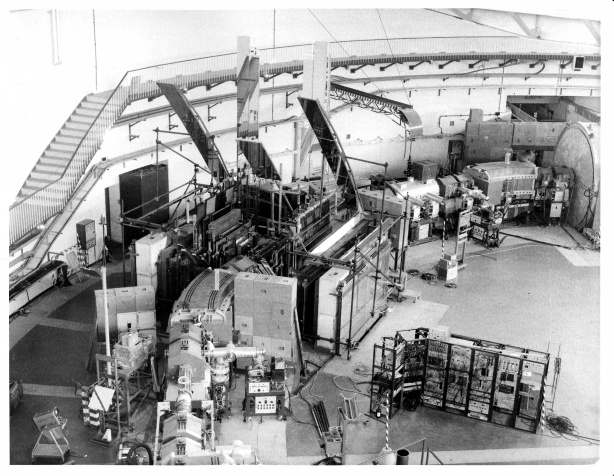
The “Mu-Pion” Experiment (Frascati, Rome, Padua) was mainly dedicated to production of muon, pion and K meson pairs from the electron-positron annihilation. The setup consisted of scintillation counters, spark chambers seen from above by means of characteristic long mirrors and water Cerenkov counters to separate the pions from K mesons. Large iron shields interleaved to the spark chambers allowed muon identification. Flash tube chambers were also part of the detection system.
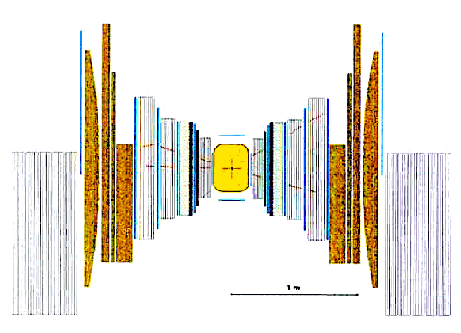
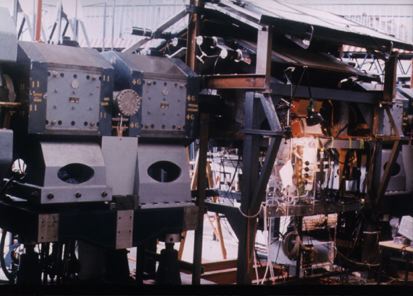
The “Boson” Experiment , run by physicists from Frascati, Naples, Pavia and Rome, employed a very compact setup, made of scintillators and wire magnetostrictive chambers, well suited to detect charged particle final states under the maximum solid angle. Its place on the interaction straight section was later taken by the “proton-antiproton” experiment (designed and run by a group from Naples) dedicated to the study of proton-antiproton production at threshold. The setup was made by scintillation counters and large gap optical chambers.

The main goals of the BCF (Bologna, CERN, Frascati) were the measurement of the pion and K mesons form factors, and the search for heavy leptons. Particular care had been paid to the calibration of the detectors, in order to guarantee a good particle identification by a system scintillation counters and spark chambers.


The experiments at ADONE produced immediately an unexpected and very important result, which became one of the main justifications in favour of the theories based on quarks as the point-like components of hadrons, the strong-interacting particles. It was observed that electron-positron collisions produced hadronic particles at a very large rate, even larger than the rate of muon pairs, which should instead be larger if nucleons and mesons were point-like themselves, not composed by other elementary sub-particles.
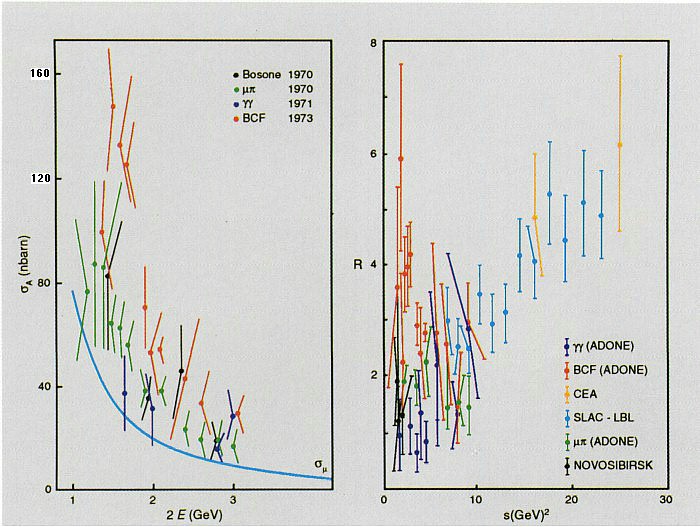
The first evidence of an anomalous multiple production came in 1970 from the measurements of the “boson” experiment. It was not demonstrated that it was due to hadrons, but it was clear that in the electron-positron collisions something happened at a rate and behaviour which could not be explained by the known quantum electrodynamics. In fact, in a single electron-positron interaction, three or more charged and neutral particles were produced at a rate larger than any prediction. The proof that the outcoming particles were hadrons was obtained from the observation of their interactions in the absorbers, since muons undergo a very small amount of nuclear interactions. The final demonstration came in 1971 from the BCF group.
The first interpretation of the experimental results from ADONE with a three quark model showed up to be not sufficient. The ratio R between the rate of electron-positron going into hadrons and muon pair production yields a direct measurement of the number of quark-antiquark pairs of mass smaller than that available from the electron-positron annihilation, and coincides with the sum of the charges of any kind of existing quark. The value of R, in the three quark model, could reach 2/3, while the observed value was clearly larger, around 2.
This value is consistent with the assumption that the quarks have a new degree of freedom, a peculiar characteristic called “colour”, which is the basis of the present theory of their interactions, quantum chromodynamics. The experimental result from ADONE was an important contribution to the development of this theory.
With the discovery of multiple production at ADONE, electron-positron physics became immediately the field of maximum interest in sub-nuclear physics, thus encouraging the construction of a large family of high energy electron-positron colliders all over the world.
Other important results, at least partially unexpected, came from the first generation of experiments at ADONE. First of all, the predictions of quantum electrodynamics in purely electromagnetic reactions were confirmed within the explored energy range, demonstrating in particular the point-like nature of electrons and muons.
Photon-photon interactions were clearly identified for the first time through the cinematic reconstruction of events with 4 electrons in the final state. In addition to the three already discovered (rho, omega and phi), the first evidence of the rho (1600) vector meson was found and the first measurement of the production rate of barionic matter and antimatter was performed. Finally, a lower limit to the mass of new leptons could be fixed, having excluded their existence in the explored energy range with a very high confidence level. The heavy lepton tau (1784 MeV) was discovered at SPEAR (Stanford) in 1975.