

 INFN-LNF Laboratori Nazionali di Frascati
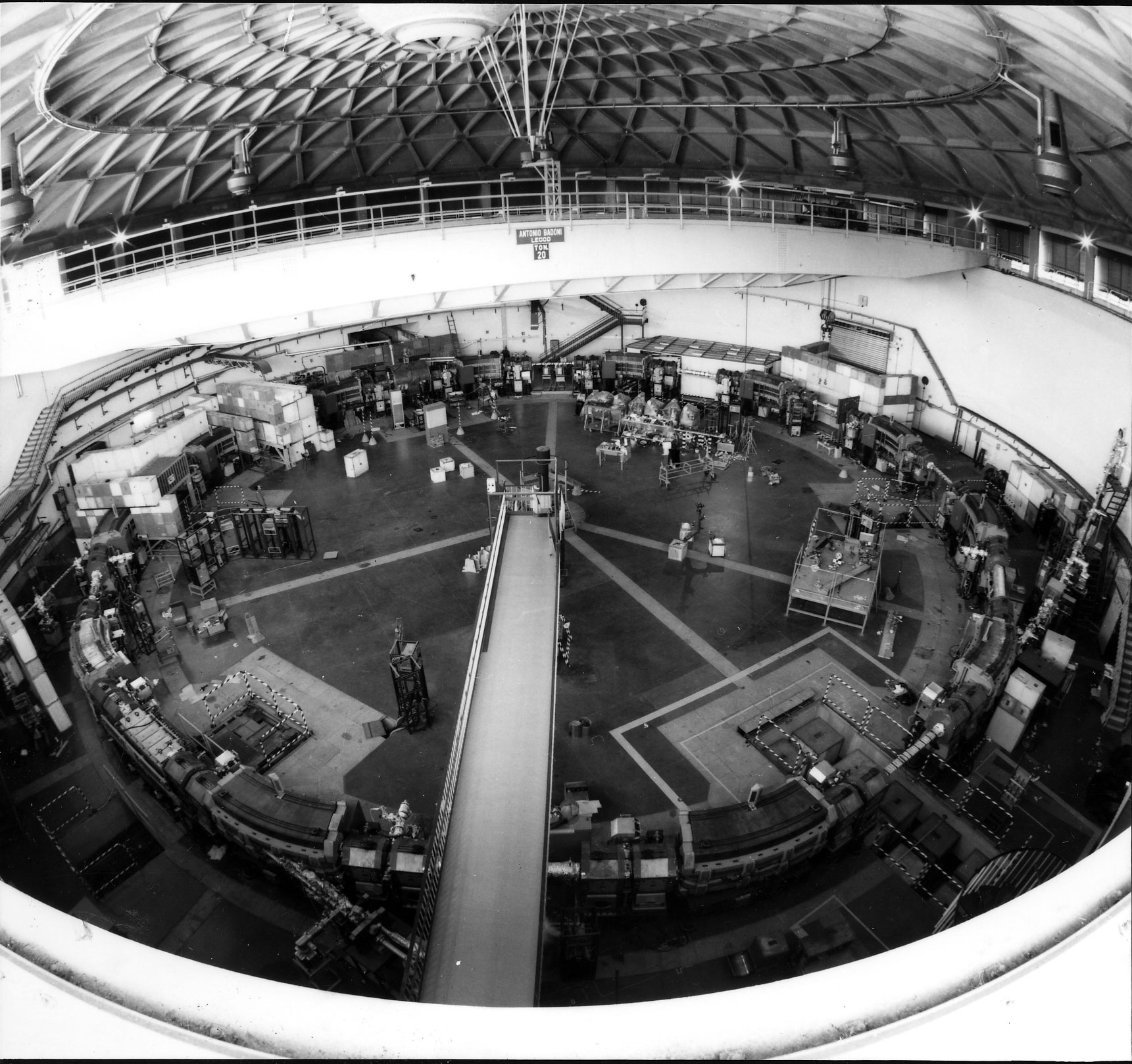
Following the success of ADA, it was decided to build in the Frascati National Laboratory a storage ring of the same kind, with larger top energy and intensity, with the aim of exploring the new energy range in subnuclear physics opened by the possibility of observing particle-antiparticle interactions with center of mass at rest.
The construction of the new machine began in 1963: a 350 MeV Linac, built by Varian (USA), was used as an electron and positron injector. This machine was capable of delivering high current (~100 mA) electron pulses of 4 µ s length at a frequency ranging from 1 to 250 pulses per second: in order to produce a positron beam a tungsten target could be inserted in the beam line to stop the electron beam after the first four high current accelerating sections (~4 A at an energy between 60 and 80 MeV): positrons were created by bremsstrahlung and pair production in the target, with an efficiency of ~0.1%.

The 1.5 GeV per beam, 105 m long storage ring is divided into 12 equal cells, each one consisting of a bending magnet with a quadrupole doublet and a half straight section on each side.
The free space in the straights available for the experiments was ~2.5 m. Four radio frequency cavities, running on the third harmonic of the revolution period (350 ns) delivered a total accelerating voltage of 120 KV.
An adiabatic closed orbit deformation obtained with by a couple of pulsed coils inside the vacuum vessel allowed multiturn injection of the long pulses coming from the Linac through a short transfer line. Three electron bunches crossed the corresponding positron ones in 6 out of the 12 available straight sections.
Two of them were occupied by the R.F. cavities, the other 4 could host the experimental setups which were able to observe the electron-positron interactions at the same time. The 6 non crossing sections were used for injection and diagnostic equipment. The luminosity of the collider was measured by detecting the rate of electron-positron small angle scattering, single and double beam-beam bremsstrahlung.
The first electron beam was stored at the end of 1967. The first positron injections immediately put in evidence a new kind of instability, the “head-tail” effect, which inhibited the storage of the required positron intensity. In parallel to the theoretical explanation of this effect a feed-back system, picking up the position of the beam and providing proper action on the beam by means of variable electromagnetic fields, was implemented on the ring, allowing the storage of the design electron and positron current and the achievement of the design luminosity of 3 x 1029 cm-2 s-1 per crossing.
The first generation experiments, and successively the second generation ones, explored the physics of electron-positron collisions up to 3.0 GeV in the center of mass, from 1969 to 1978. After that time, the storage ring was deeply modified, in order to be used with the electron beam as a source of synchrotron radiation (PULS, PWA) and of monochromatic, intermediate energy gamma-ray beams for nuclear physics (LADON) obtained by colliding the electron beam with a laser. The main changes in the storage ring structure were a new single radiofrequency cavity, running at 51 MHz on the 18-th harmonic of the revolution period and the replacement of the vacuum vessel with the introduction of a distributed system of detection and correction of the beam position, in order to accurately control the source points for the beam lines. Still for nuclear physics experiments, an internal gas target (JET TARGET) was realised in 1988: it consisted of an Argon (and successively other gases) beam shot at the velocity of sound at right angle on the electron beam, producing an intense gamma-ray beam. Finally, in 1991, electron-positron operation was resumed to study neutron-antineutron production and measure the nucleon form factors (FENICE experiment). The beam from the Linac was also used directly for nuclear physics experiment (LEALE).

ADONE was shut down on April 26, 1993 to allow the construction of a new low energy, high luminosity collider, DAFNE, inside its building: Prof. Giorgio Salvini, the first Director of the Frascati National Laboratory switched off the last stored beam, after 24 years of operation, during which ~22000 hours of colliding beam and ~5300 hours of single beams had been delivered to the experiments.