 INFN-LNF Laboratori Nazionali di Frascati
Synchrotron radiation, as it is called the electromagnetic radiation emitted by electrons stored in a circular ring, is now one of the most helpful tools for research in physics, chemistry, biology and advanced technological applications.
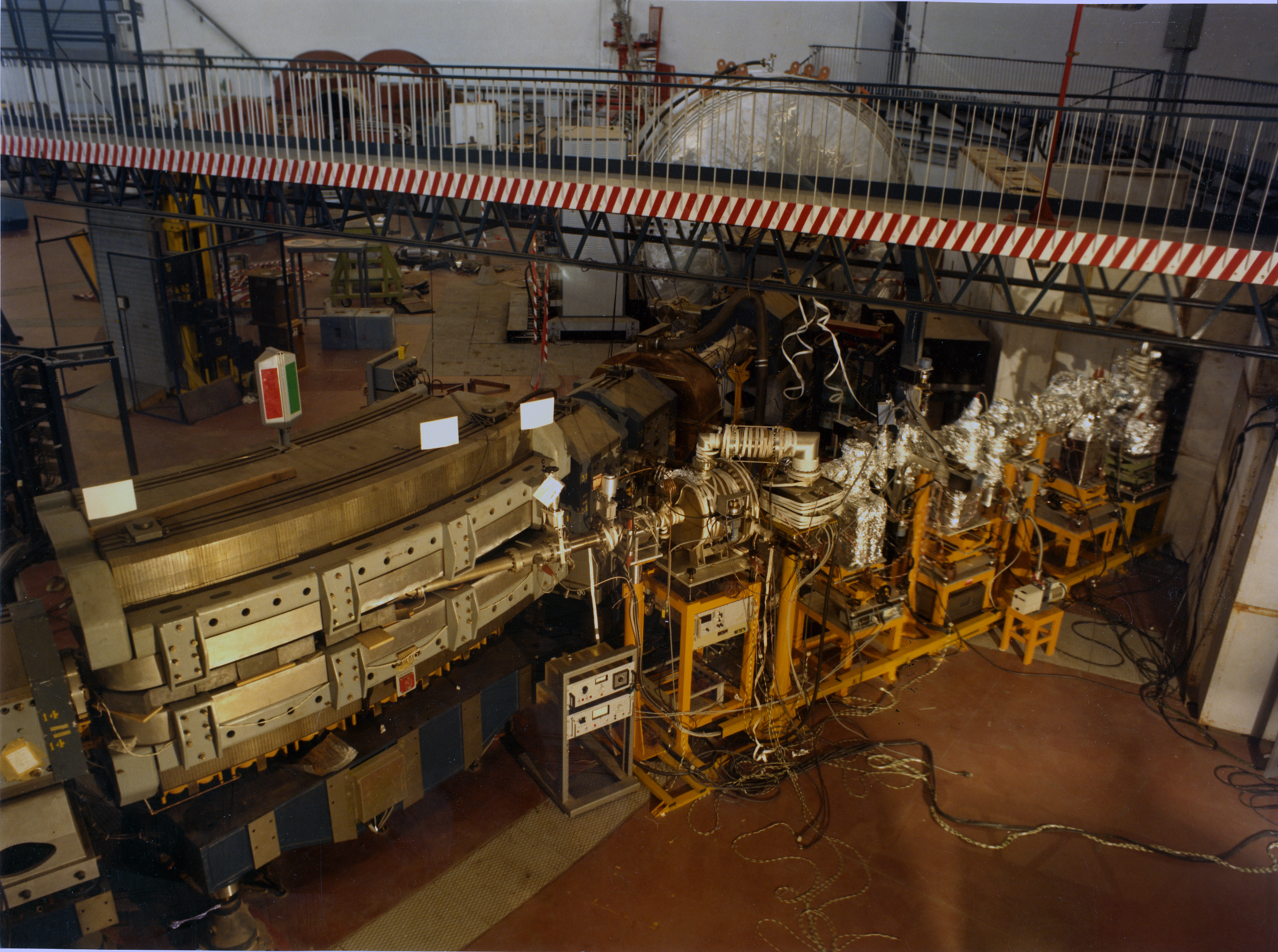
The synchrotron radiation has been used for the first time in the early sixties at the Frascati Electron Synchrotron for research in the field of solid state physics. After those first pioneering experiments, in 1978, a systematic utilisation of the synchrotron radiation from ADONE, emitted at high intensity and short pulses on a spectrum extending from the ultraviolet to soft X-rays, was started.
The light was separated in several bands of well defined wavelength, concentrated by means of mirror systems and directed towards the PULS (Progetto Utilizzo Luce di Sincrotrone) laboratory, where it was used to perform experiments in the fields of atomic and molecular spectroscopy, materials structure, semiconductor properties, photochemistry and biophysics.
Synchrotron radiation in the hard X-rays energy range, above that produced by the electrons in the ADONE bending magnets, has been obtained in Frascati by inserting into a straight section of ADONE a special magnet, called “wiggler”, made of poles of alternating polarity, where the electrons are forced to perform a sinusoidal type trajectory. In this way one can exploit a maximum field larger than the bending magnets one and sum up the intensity of the radiation from the peaks of the electron trajectory inside the wiggler.
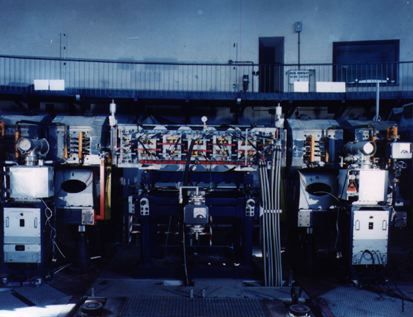
Because of the high “brilliance” of the machine (the number of photons per second emitted by the beam per unit source surface and per unit solid angle), it was possible to realise an intense source of X-rays with an energy between 3 and 30 KeV, for a large research program in several research and technology fields, called PWA (Progetto Wiggler Adone). The experimental activity of PWA started in 1980 with a series of experiments of atomic absorption spectroscopy in a wide energy spectrum and of atomic structure analysis.
The X fluorescence induced by the synchrotron radiation allows the identification of elements present inside a given specimen at a density of the order of one part per million: this kind of analysis has been widely used in PWA for industrial applications, medicine, environment control, study of artistic pieces and dating. The X fluorescence technique enables also the simultaneous analysis of different chemical elements in the specimen under observation.
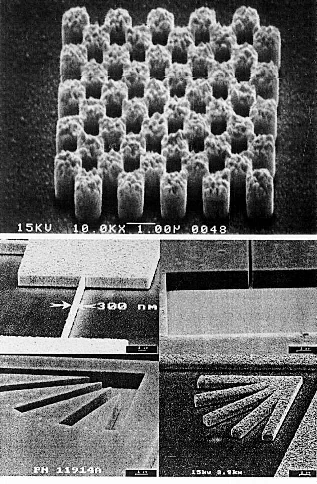
Beams of high intensity and energy resolution in the X-ray bandwidth enable advanced microscopy experiments and can be utilised for lithographic engraving with a precision of the order of microns. In X-ray lithography the photon beam can transfer a frame, even very complicated, from a master mask to the surface to be engraved, reducing it to microscopic size. This kind of technique has also been developed and used in PWA.