

 INFN-LNF Laboratori Nazionali di Frascati
The results of the experiments at ADONE stressed the limits of the first generation detectors, designed under the assumption, immediately contradicted by the observations, that only few particles could be found in the final states of electron-positron annihilation.
The great interest towards the study of electron-positron collisions arisen from the first results required improvements both in the storage ring operation and the development of new and more complex detectors, taking into account the most recent technological developments in the particle detector field.
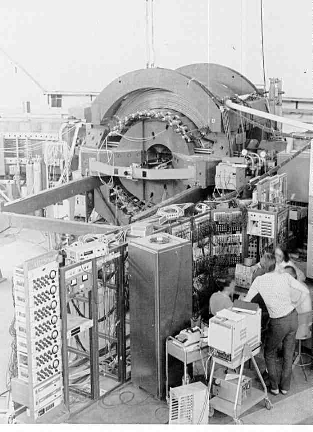
In particular, the requirement of a complete analysis of the final states particle properties asked for a detector placed in a magnetic field to discriminate the charge and measure the particle momentum.
In order to fulfil this requirement, researchers from Frascati, Naples, Padua and Rome realised MEA (Magnete Esperienze Adone), a detector made of large gap chambers and spark chambers, placed inside a large solenoidal magnet.

The Gamma-Gamma 2 Experiment was the natural development of the Gamma-Gamma Detector (scintillation counters, converters and spark chambers), covering a larger solid angle with a better sampling of electromagnetic and hadronic showers.
In Gamma-Gamma 2 lavorarono ricercatori di Frascati e Roma.

The Baryon-Antibaryon Experiment was designed to study proton-antiproton and, more generally, any baryon-antibaryon pair, similar to protons, but with a larger mass, looking mainly at the energy threshold of the reaction.
The detector consisted in large liquid scintillators, wire chambers with magnetostrictive reading and flash tube chambers. The experiment was realised by a collaboration between Frascati, Naples, Pisa and Istituto Superiore di Sanità.
In November 1974 the field of subnuclear physics was deeply upset by the discovery of a new, completely unexpected particle, characterised by an extraordinary stability for its large mass, ~3.1 GeV. The particle was discovered at the same time at the electron-positron storage ring SPEAR at Stanford (where it was called “psi“) and at the proton synchrotron of the Brookhaven National Laboratory, near New York, where it was called J.
The energy in the center of mass needed to produce the new particle was only ~0.1 GeV above the nominal operating energy of ADONE: this explains why it was not discovered before at ADONE. However, it was decided to push the performance of the machine beyond its standard parameters, in the energy range indicated by the american laboratories. After three days the signal of the new particle appeared in an extremely clear way, as a very high cross section within a so small width, that it was completely hidden by the intrinsic energy spread of the particles interacting in the collider. The second generation detectors at ADONE had unique features to identify some peculiar aspects of the new particle, and in this way they were able to give significant contributions to the measurement of its properties. In addition, it was decided to scan the whole energy range of ADONE in small steps (1 MeV) to look for the existence of other narrow resonances of lower energy.

The importance of the J/psi discovery lies in the fact that it is the proof of the existence, in addition to the already known three quarks, of a new type of quark, currently called “charm”, which represents a new class of fundamental constituents of matter. Its existence was already foreseen in 1970 by Sheldon Glashow, John Iliopulos and Luciano Maiani, in order to include the behaviour of the quarks within a unified theory of electromagnetic and weak forces, and explain in a very elegant way the absence of some weak decays of strange particles.