 INFN-LNF Laboratori Nazionali di Frascati
A collaboration between the INFN Frascati National Laboratory, SLAC, and ENEA has demonstrated for the first time the emission of 700 nm FEL radiation generated by an electron beam accelerated in a plasma and then compressed to a few femtoseconds.
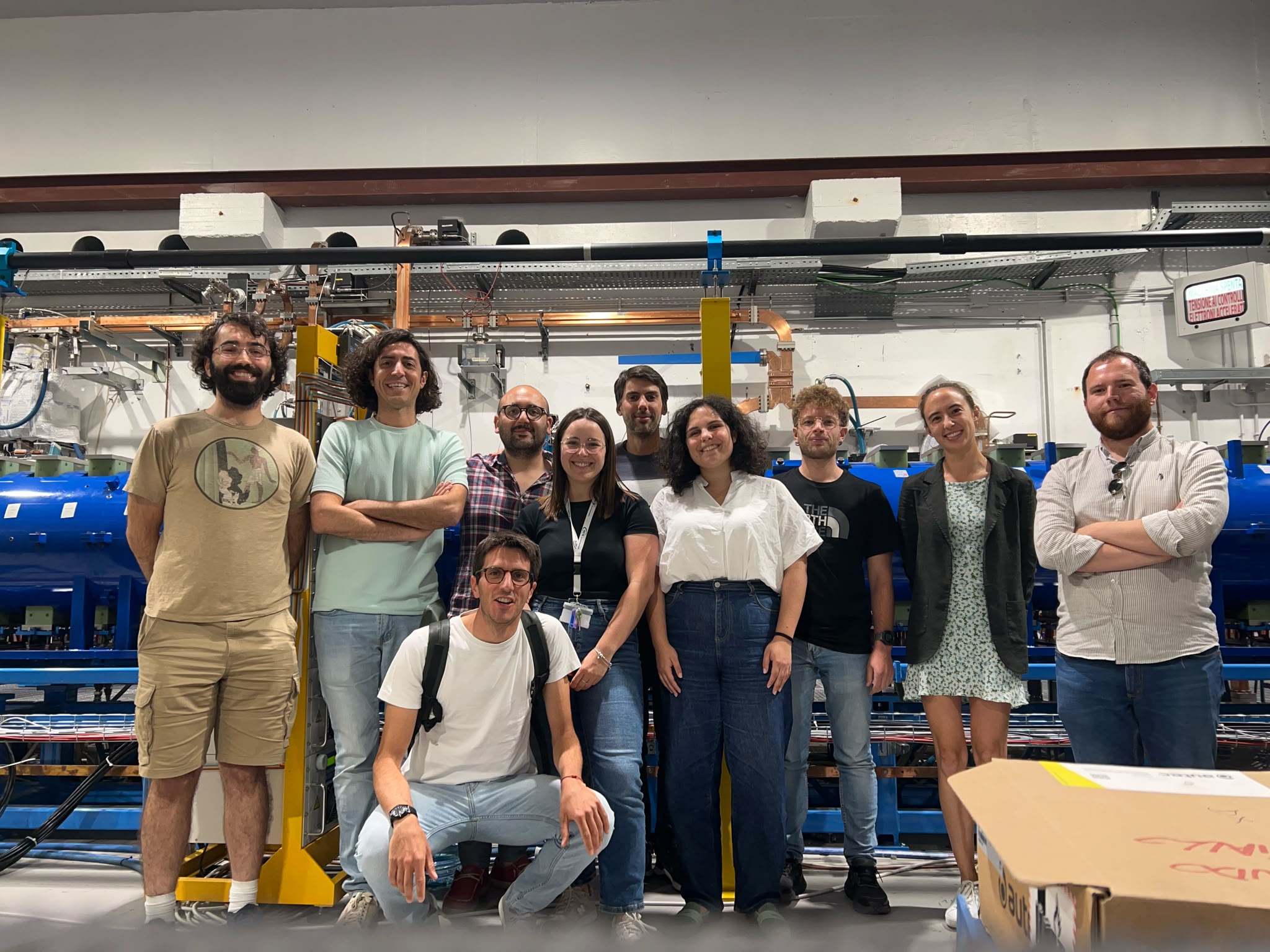
A collaboration between researchers from the SPARC_LAB group at LNF-INFN, FACET-II at SLAC, and ENEA Frascati has experimentally demonstrated the emission of ultra-short-wavelength radiation from a Free-Electron Laser (FEL) using an electron beam accelerated in a plasma. The experiment, carried out with the SPARC_LAB photoinjector, brought together Italian researchers and their American colleagues for a month-long campaign. The results represent a significant step toward next-generation, compact, and cost-effective FEL light sources.
Plasma Acceleration and Beam Compression
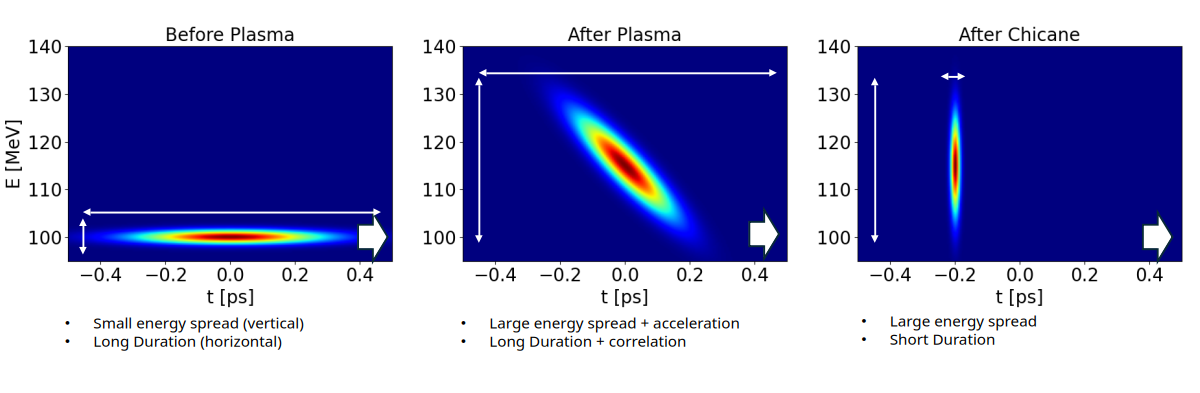
Plasma acceleration (PWFA) uses the electric fields generated by the oscillation of a plasma traversed by an electron beam or laser pulse to accelerate particles over distances much shorter than conventional radio frequency accelerators——from meters to centimeters. One of the distinctive features of this technology is its ability to impart a high energy chirp to the accelerated beam, i.e., a strong correlation between the longitudinal position of the particles within the bundle and their energy.
In the experiment conducted at SPARC_LAB, this chirp was exploited to further compress the beam after plasma acceleration by passing it through a magnetic chicane. The result was an electron bunch with an estimated duration of just 10–20 femtoseconds, a critical condition for efficiently triggering the emission process of ultrashort-wave FEL radiation.
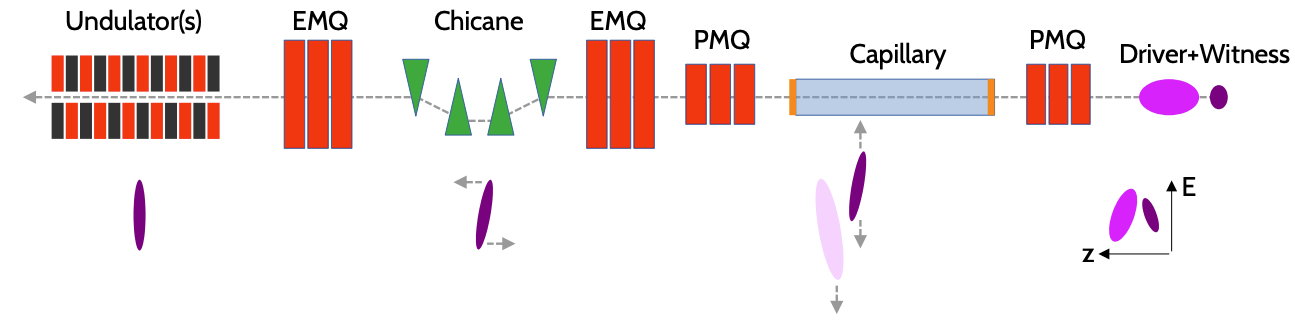
A particularly promising aspect of this technique—the combined use of energetic chirps induced in the plasma and subsequent compression into chicanes—is its potential for scalability to even shorter beam durations, in the attosecond regime. Such short electron bundles would pave the way for equally short FEL pulses, with applications in the study of ultrafast electronic dynamics in atoms, molecules, currently accessible only to a very small number of large laboratories worldwide.
FEL emission in the SPARC_LAB undulator
Once compressed, the electron beam was sent into an undulator, the periodic magnetic device that forces the electrons to oscillate transversely, inducing the emission of coherent electromagnetic radiation. The observed FEL radiation was centered at 700 nanometers, with a spectral bandwidth of about 100 nanometers and a pulse energy of about 10 nanojoules.
The combination of such a short beam duration and a relatively broad emission bandwidth is consistent with an emission regime strongly influenced by the characteristics of the plasma-accelerated beam, and provides a valuable testbed for understanding how the unique properties of these beams—high peak currents, ultrashort durations, and a non-negligible energy spread—translate into the properties of the generated FEL light.
Why is this result important?
Conventional FEL sources, such as those operating at large X-ray facilities, require linear accelerators hundreds of meters or kilometers long to bring the electron beam to the required energy. The ability to generate FEL light from a plasma-accelerated beam opens the way to sources of dramatically reduced size and cost, while maintaining the coherence and brightness typical of FEL radiation.
This experiment, conducted entirely at SPARC_LAB thanks to the synergy between the Frascati group’s expertise and that of the FACET-II group, represents a concrete demonstration that the entire chain, from plasma acceleration to the generation and characterization of FEL radiation, can be successfully implemented in a single facility.
“This result demonstrates that a plasma-accelerated beam, despite its complexity, can be manipulated and compressed with the precision necessary to trigger FEL emission,” commented Riccardo Pompili, scientific coordinator of the SPARC_LAB activities, also adding “that the next step will be to optimize the beam quality to increase the energy and stability of the emission.”
Next steps
The experiment conducted at SPARC_LAB represents a proof of principle of the technique: the next step of the collaboration will be to transfer it to FACET-II, where the electron beam can reach energies on the order of 10 GeV. At these energies, the same combination of energy chirping in the plasma and compression in a chicane could make it possible to generate FEL radiation not in the visible range, but in the X-ray frequencies, with both the electron beam and light pulse reaching attosecond durations.
The SPARC_LAB group and their FACET-II colleagues will therefore continue their collaboration with the aim of improving the quality of the plasma-accelerated beam and testing, at higher energies, the scalability of the results obtained in Frascati. The data collected will be used to validate the theoretical and numerical models developed by the group and to guide the design of future compact X-ray FEL sources based on plasma acceleration.