

 INFN-LNF Laboratori Nazionali di Frascati
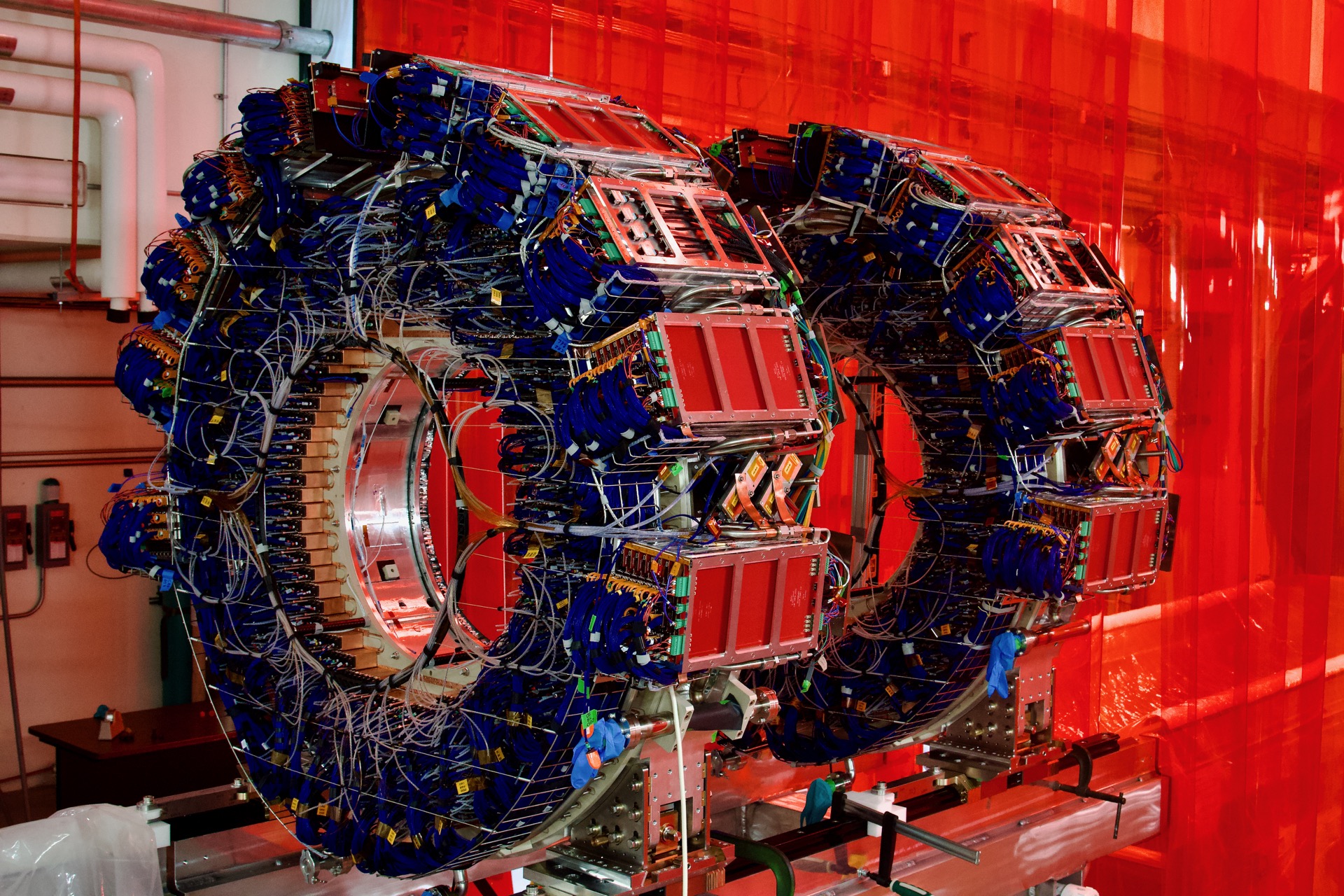 A significant step forward for the Mu2e experiment at Fermilab: the electromagnetic calorimeter, one of the fundamental components of the experiment, has been completed and installed in the experimental hall. The calorimeter was primarily designed and built thanks to the Italian collaboration, with the INFN Frascati National Laboratories (LNF) leading both the technical and management aspects of the project.
Mu2e is one of the most advanced experiments in the search for physics beyond the Standard Model at the intensity frontier focusing on charged lepton flavour violation (cLFV). The name itself — Mu2e, standing for muon to electron — clearly explains the goal: to search for the direct conversion of a muon into an electron, without the emission of neutrinos, in the presence of an aluminum nucleus electric field. The process, forbidden by the Standard Model of particle physics, is predicted by many theories that extend it.
Mu2e’s ambitious goal is to improve the sensitivity on the conversion signal by four orders of magnitude with respect to previous experiments, reaching the limit of 3 × 10⁻¹⁷. To achieve this, around 10¹⁸ muons will need to be stopped on the target — a number comparable to all the grains of sand on Earth. The experiment relies on cutting-edge infrastructure, including a dedicated muon beamline for the production, selection, and transportation of muons to the target, with a flux of about 10 billion negative muons per second. The beamline consists of three superconducting magnets — the Production Solenoid (PS), the Transport Solenoid (TS), and the Detector Solenoid (DS) — for a total length of 25 meters. The TS, whose coils were all built in Italy by ASG Superconductors (Genova), was installed in 2024; the PS was installed in early August 2025, while the DS, whose installation is scheduled for March 2026, will mark the experiment’s official start.
The signal Mu2e is searching for is that of a monoenergetic electron with energy (104.97 MeV) very close to that of the muon rest mass. To distinguish these extremely rare events from the background produced by electrons from muons’ ordinary decays, it is necessary to reconstruct the particle momentum with very high precision (< 200 keV) and identify them as electrons. This task is handled by two detectors inside the DS: the ultra-lightweight tracker, made of 20,000 15 μm-thick mylar straws, and the crystal-based electromagnetic calorimeter, responsible for distinguishing electrons from muons by means of energy and time-of-flight measurements.
The calorimeter is made up of two aluminum disks, each containing 674 pure Cesium Iodide (CsI) crystals. Each crystal is read out by two silicon photomultipliers (SiPMs), connected to fast analog electronics and a digital readout system with a 5 ns sampling rate. This detector ensures excellent energy and time resolution performance (< 10% and 500 ps at 100 MeV), while operating in extreme conditions due to the high particle flux and experimental requirements: it must function in vacuum (10⁻⁴ Torr) and withstand a high-radiation environment, including both charged and neutral particles.
The design, construction, testing, and installation of this detector required an intense effort by the calorimeter team, composed of INFN groups from the LNF, Pisa, Ferrara, Lecce, and Trieste INFN Units, the collaboration of JINR of Dubna, and the University of Caltech. After a three-year development phase, construction began in 2016 with the production and testing of 1,500 crystals, 4,000 SiPMs, and the construction of the mechanical support and cooling system. In early 2020, the COVID-19 pandemic stopped the work at Fermilab, but thanks to the joint efforts of technicians, engineers, researchers, fellows, PhD students, and students from LNF, the assembly was transferred to and successfully continued in Italy.
Over the past three years, final assembly, cabling, and signal testing — carried out in a clean room at Fermilab — have seen constant leadership and participation from the LNF group, culminating in the delivery of the two fully functioning disks in June 2025. Transport from the assembly area to their position on the rails in the Mu2e experimental hall was completed successfully on September 11, 2025, for the first disk, and September 16, 2025, for the second.
“A well-deserved thank you,” says Dr. Stefano Miscetti, Mu2e spokesperson and technical coordinator of the calorimeter, “goes to the entire calorimeter team, with special mention of the LNF team, the vacuum service, the electronics department, the group and workshop technicians, and the entire laboratory, as well as INFN, for the support provided. I am proud of the work done so far and hope this major milestone brings us closer to the successful start of the long commissioning and beam operation phase.”