

 INFN-LNF Laboratori Nazionali di Frascati
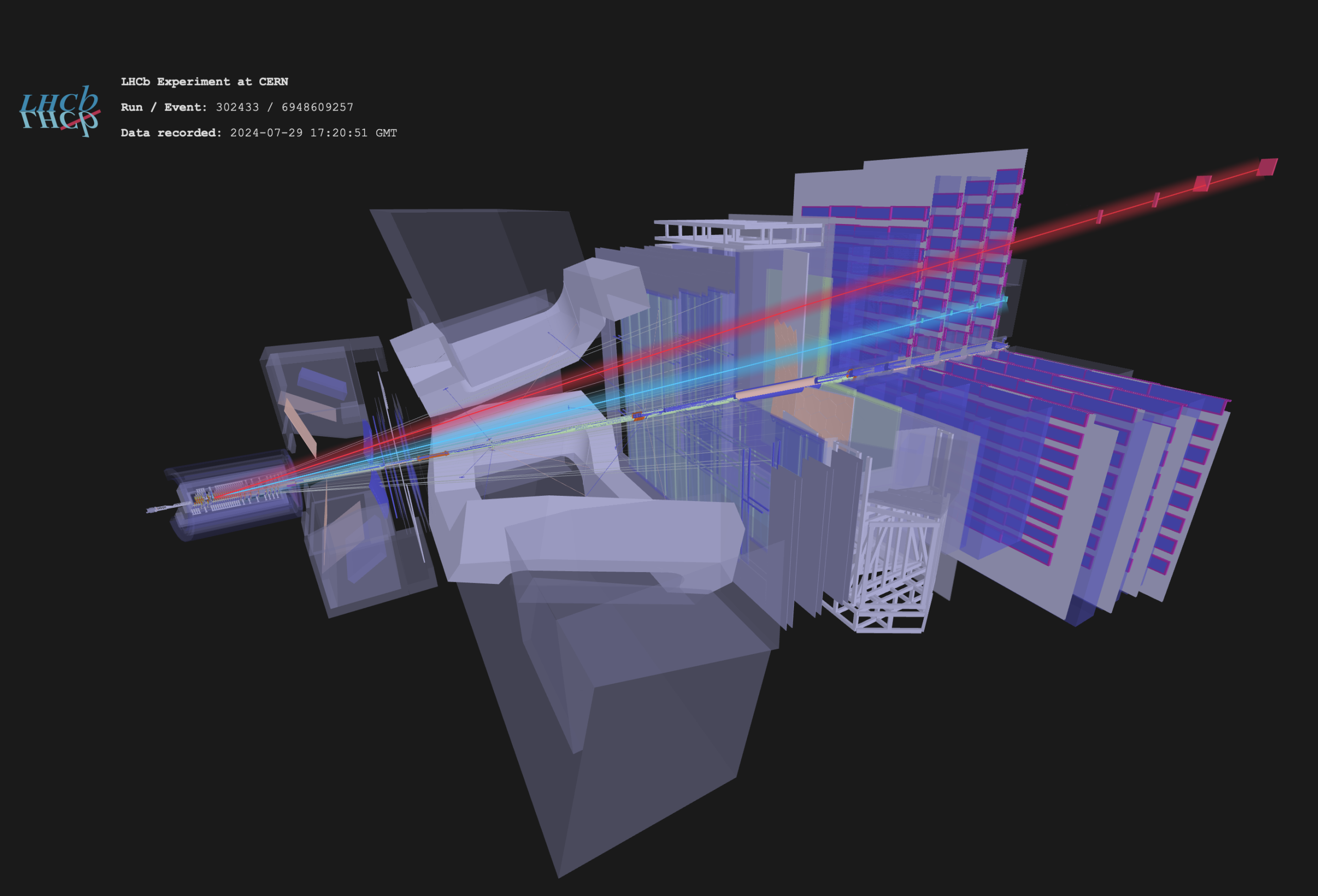 The analysis that found evidence for the B⁰ → μ⁺μ⁻ decay was co-led by Marco Santimaria, researcher at INFN’s Frascati National Laboratory. The experiment’s muon system, which includes detectors built in Frascati, played a crucial role.
On 3 November 2026, at a seminar in Geneva, CERN’s LHCb experiment presented evidence for an extremely rare decay of a beauty particle, occurring only once in ten billion events: the decay of the B⁰ meson into a pair of muons (μ⁺μ⁻). This marks the first time an experiment has succeeded in measuring this process, completing a search that began in 1984 with the CLEO experiment at Cornell University (USA). The analysis was co-led by Marco Santimaria, researcher at INFN’s Frascati National Laboratory (LNF), who headed an international team of 19 physicists from Italy, the United Kingdom, Germany, Spain and the Netherlands.
The B⁰ meson consists of a beauty quark and a down antiquark. In the Standard Model of particle physics, this decay is extremely rare, and measuring its frequency precisely—and detecting any deviation from the expected value—could provide evidence for the existence of as-yet-unknown particles. This is why precision measurements such as this one are among the most powerful tools for searching for “new physics”. The signal observed by LHCb has a statistical significance of 3.2 standard deviations, corresponding to a probability of about one in 1500 that it is due to a statistical fluctuation. The result is also consistent with the predictions of the Standard Model, confirming its validity even for such extraordinarily rare processes.
To identify muons, LHCb relies on a 435 m² system of multi-wire proportional chambers (MWPCs), many of which were built at LNF, and have been collecting data for more than 15 years.
In 2022, LHCb underwent a major upgrade (Upgrade I), to collect data at a collision rate five times higher, analyzing more than one hundred million proton–proton collisions per second, which produce a data flow of 4 terabytes/s. The result just published combines the data collected in the 2024–2025 and 2011–2018 periods.
“For more than forty years, physicists have been searching for this decay,” says Marco Santimaria. “Identifying muons amid an enormous background is the real challenge of this measurement, and it is also at the heart of the work carried out by our analysis group in Frascati.”
“The excellent performance of the muon system with Run 3 data was crucial in identifying the rare decay of B mesons into two muons with high purity. Finally seeing this signal rewards the work of the many people who built and operated the detector,” emphasises Barbara Sciascia, Muon Project Leader for the experiment.
“The Italian LHCb community is already working on the experiment’s upgrade, which will increase its data-collection capacity by a further factor of ten over the next decade, opening up exciting opportunities for the study of rare decays and the search for new physics,” adds Pasquale Di Nezza, researcher at the Frascati National Laboratory and national coordinator of the LHCb collaboration.
With LHCb Upgrade II, around the middle of the next decade, these decays will be measured with precision. We will then know whether the Standard Model holds up at this level of detail or whether as-yet-unknown particles and forces will emerge.
The LHCb experiment is one of the four major detectors installed along the ring of CERN’s Large Hadron Collider (LHC) in Geneva. It is a precision instrument dedicated to the study of quark “flavour” physics. Its aim is to investigate the beauty quark (or b quark) and its antimatter counterpart in order to identify possible deviations from theoretical predictions—and, with them, hints of physics beyond the Standard Model.
The Frascati LHCb group consists of 25 researchers and several technicians. In addition to having consistently held national and international coordination responsibilities, the group is engaged in numerous cutting-edge data analyses and in the development of next-generation gas detectors for the muon detector upgrade, as well as in work on the electromagnetic calorimeter and the polarised gas target.