

 INFN-LNF Laboratori Nazionali di Frascati
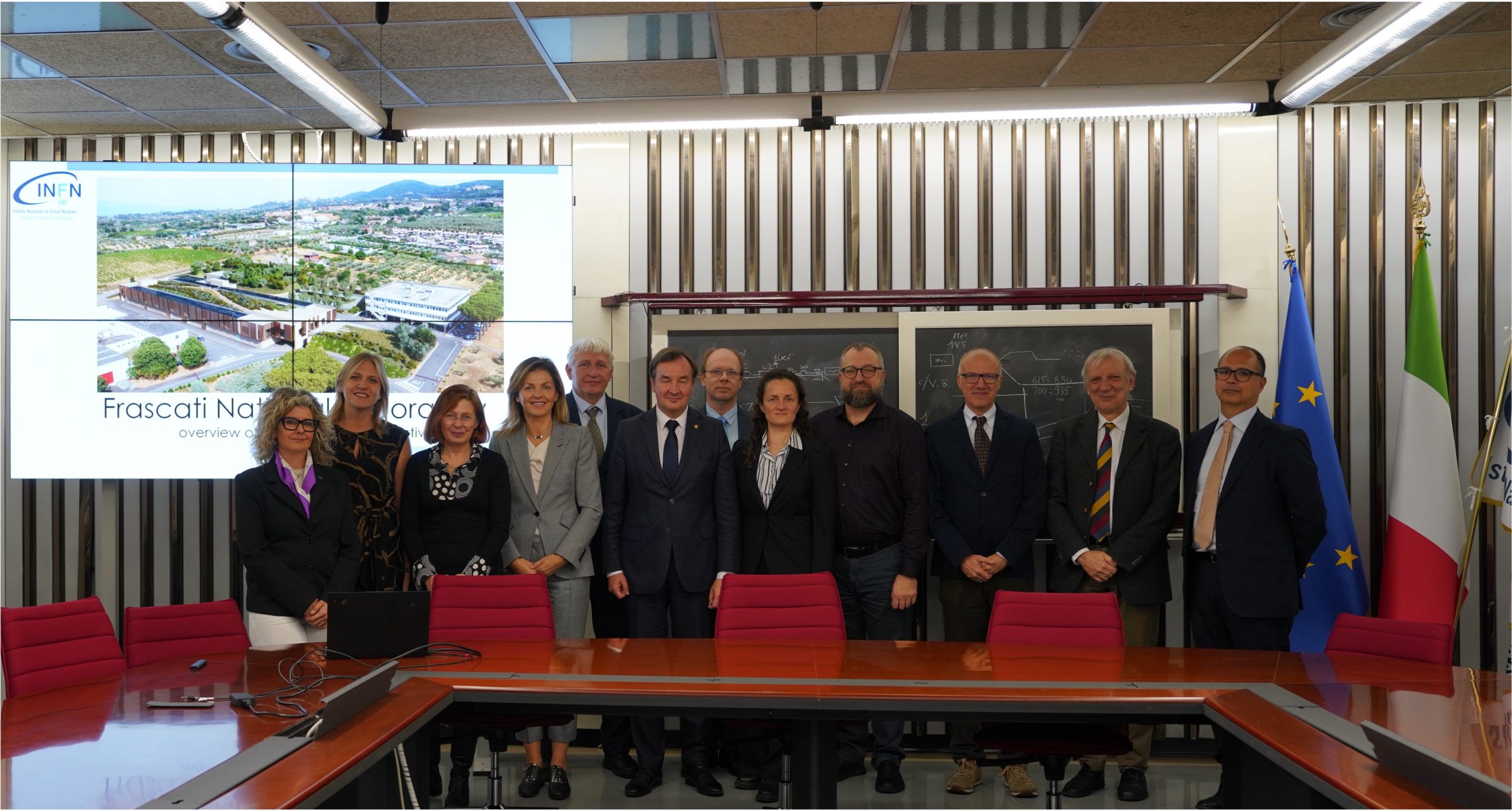 The National Institute for Nuclear Physics (INFN), Vilnius University and the Center for Physical Sciences and Technology (FTMC) signed a Framework Agreement in Rome aimed at strengthening scientific and technological cooperation between Italy and Lithuania on 30 October 2026.
The agreement, signed at the INFN Headquarters, represents a new step in the collaboration path launched earlier this year between the research institutions of the two countries.
The agreement promotes joint activities in strategic areas of interest ranging from particle physics to nuclear physics and astrophysics, from research on dark matter and gravitational waves, for the Einstein Telescope, to laser, quantum and high-performance computing technologies. The agreement also provides for the promotion of exchanges of researchers, programmes for young postdoctoral researchers, training activities, workshops, conferences and other joint initiatives aimed at fostering the growth of scientific collaborations between the two research communities.
The signing of the Framework Agreement follows on from the dialogue launched at the beginning of the year, when a Lithuanian delegation composed of representatives of scientific institutions and the Embassy of the Republic of Lithuania in Italy met with the INFN board to explore new opportunities for collaboration. On that occasion, a number of topics of common interest that are now the subject of the agreement had already been identified.
Following the signing ceremony, the delegation visited the INFN Frascati National Laboratory, where they toured the SPARC_LAB facility and the DAFNE accelerator.
The delegation was accompanied by Laboratory Director Paola Gianotti, Research Division Head Matteo Paluan, and Accelerator Division Head Alessandro Gallo.
The Ambassador of the Republic of Lithuania to Italy, H.E. Dalia Kreivienė, claimed: “Science diplomacy is a strategic tool for strengthening our competitiveness, building international partnerships and addressing global challenges. By driving innovation, fostering mutual trust and building bridges between countries, science plays an increasingly important role in international relations. Lithuania and Italy both have strong scientific communities with internationally recognised expertise, offering significant opportunities for cooperation in advanced physics and emerging technologies. The Embassy of Lithuania in Italy has made science diplomacy one of its priorities, investing considerable effort in bringing together the scientific communities of our two countries. This Framework Agreement is a tangible result of these efforts and an important milestone in developing long-term scientific partnerships and strengthening bilateral relations between Lithuania and Italy. The participation of the Rector of Vilnius University in today’s ceremony further highlights the close connection between science and diplomacy and our shared commitment to advancing this cooperation”.
Antonio Zoccoli, President of INFN, stated that “The Framework Agreement signed today marks an important step in strengthening the scientific ties between Italy and Lithuania. INFN, Vilnius University and FTMC already share scientific interests in several frontier research areas, from particle and nuclear physics to gravitational waves, quantum technologies and advanced computing, as well as in major international projects such as Einstein Telescope. This agreement provides a structured framework to further develop these collaborations, promote the exchange of researchers and create new opportunities, particularly for early-career scientists and postdoctoral researchers. Addressing the major scientific and technological challenges of our time increasingly requires international cooperation, and we are pleased to contribute to building a long-term partnership between our research communities.”
Rimvydas Petrauskas, Rector of Vilnius University, added that “The agreement we sign today builds on strong foundations. It connects the world-class research infrastructure of INFN with the broad academic strengths of Vilnius University and the scientific expertise of Lithuania’s research community. Our cooperation already spans some of the most exciting challenges in modern science, from dark matter and nuclear physics to advanced computing and laser technologies. The image of the Frascati synchrotron on the commemorative stamp reminds us that great scientific achievements begin with bold ideas and sustained institutional commitment. In the same spirit, projects such as EuPRAXIA and Europe’s laser research infrastructures demonstrate how international collaboration can push the boundaries of knowledge and innovation. Most importantly, this agreement creates new opportunities for researchers and students, strengthens links between our countries, and ensures that this partnership will continue to grow for years to come. Today, we celebrate not only a signature but a shared future in science”.
Lina Mikoliūnaitė, FTMC Deputy Director for Science, emphasized that “The signing of the Framework Agreement between INFN, FTMC and Vilnius University marks an important milestone in strengthening scientific cooperation and opening new horizons for joint research. Our institutions already share strong scientific interests in several frontier research areas, ranging from particle and nuclear physics to gravitational waves, and advanced computing. This agreement provides a valuable foundation for transforming these shared interests into ambitious collaborative projects, fostering the exchange of knowledge and expertise, and creating new opportunities for researchers, particularly early-career scientists and postdoctoral fellows. FTMC is truly delighted and honoured to be part of this important initiative. We believe that bringing together the complementary expertise, scientific excellence, and research capabilities of our institutions will inspire groundbreaking discoveries and contribute to extraordinary scientific achievements in the years ahead.”
Paola Gianotti, Director of the Frascati National Laboratory, highlighted that: “The Lithuanian delegation expressed its appreciation for the LNF research facilities and its hope that specific collaborations could be established in areas of mutual interest. For our part, we are fully committed to this prospect and look forward to future developments.”